
Palmetto Publishing has released Uncut Stones of the Soul, a collection of free-verse poetry by John D. Aram that moves from the stillness of a wood’s edge at dawn to the fractured center of American civic life. Aram, a former professor at Case Western Reserve University and Lesley University, spent decades studying institutions, power, and human behavior from inside the academy. Now, in a turn that surprises even him, he has channeled analytical rigor into verse. The result is a book that reads less like a literary debut and more like a reckoning: one generation’s unflinching self-examination, delivered in plainspoken lines that refuse to look away.
The tension at the heart of Uncut Stones of the Soul is elemental. Aram writes as a person caught between gratitude and alarm, between the luminous private moments that define a life and the civic collapse unfolding around him. Inequality deepens. Political disaffection hardens. The democratic experiment his generation inherited shows visible cracks. The stakes are not abstract. They are the gap between the country these poems remember and the country they describe, a gap that widens with each page and leaves no comfortable ground on which to stand.
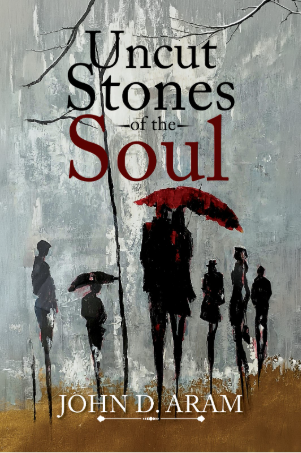
The collection unfolds in three deliberate movements. It opens with contemplative poems that explore identity, impermanence, and the chrysalis moments of personal transformation, grounding the reader in the intimate geography of the self. It then pivots outward, confronting modernity’s contradictions, economic injustice, and the recurring human capacity for cruelty with a directness rare in contemporary poetry. In its final movement, the book pays tribute to democracy’s defenders and issues a clarion for civic renewal, insisting that extraordinary human capacities remain available if citizens choose to use them.
Uncut Stones of the Soul arrives at a moment when Americans across the political spectrum are searching for language that matches the gravity of their lived experience. Aram offers no slogans, no easy comfort. He offers the moral seriousness of a person who has spent a lifetime inside institutions and has emerged asking whether they have kept their promises. For readers weary of shallow discourse, these poems provide something rarer: a voice that is self-critical, outspoken, and willing to hold beauty and unease in the same breath. That honesty is precisely what makes the book difficult to set down.
John D. Aram, a former professor of organizational behavior and management policy who turned to poetry to reckon with his generation’s civic legacy, reflects on what compelled him to write Uncut Stones of the Soul, saying, “I spent my professional life studying how institutions shape human behavior, and I never imagined I would turn to poetry. But analysis alone could not hold what I needed to say. I wanted to give voice to what I find both heartening and darkening, to be honest about where my generation has fallen short, and to insist that the values we claim to hold are worth fighting for. These poems are my attempt at that honesty.”
Uncut Stones of the Soul belongs on the shelf alongside Wendell Berry’s The Peace of Wild Things, Mary Oliver’s Devotions, and Adrienne Rich’s The Dream of a Common Language. It speaks directly to socially conscious, civically engaged adult readers who value contemplative free verse with moral weight. As democratic institutions face renewed scrutiny and Americans grapple with generational accountability, this collection meets an urgent cultural moment. Booksellers and librarians will find it a natural fit for poetry, political science, and current affairs displays. Its accessible, plainspoken style makes it equally suited for book clubs, university courses, and podcast conversations about citizenship and legacy.
Uncut Stones of the Soul is available for purchase online at Amazon.com and BarnesandNoble.com.
About the Author
John D. Aram earned his B.A. in Economics from Yale University and his Ph.D. in Management from the Massachusetts Institute of Technology. He served as Professor of Organizational Behavior and Management Policy at the Weatherhead School of Management, Case Western Reserve University, and later as Professor and Associate Dean at the Graduate School of Arts and Social Sciences, Lesley University. His academic career gave him a rigorous analytical lens through which to examine self and society.
Having spent his professional life outside literary circles, Aram came to poetry as a means of reckoning with what he finds both inspiring and dispiriting in American life. Uncut Stones of the Soul is born from that impulse: a collection that is at once contemplative and politically outspoken, examining the beauty and unease of the self alongside the social and political legacy of his generation. His poems confront the nation's struggle to sustain an inclusive, equitable, and democratic society while calling on readers to reaffirm its founding values. His voice is direct, self-critical, and unapologetically candid.