
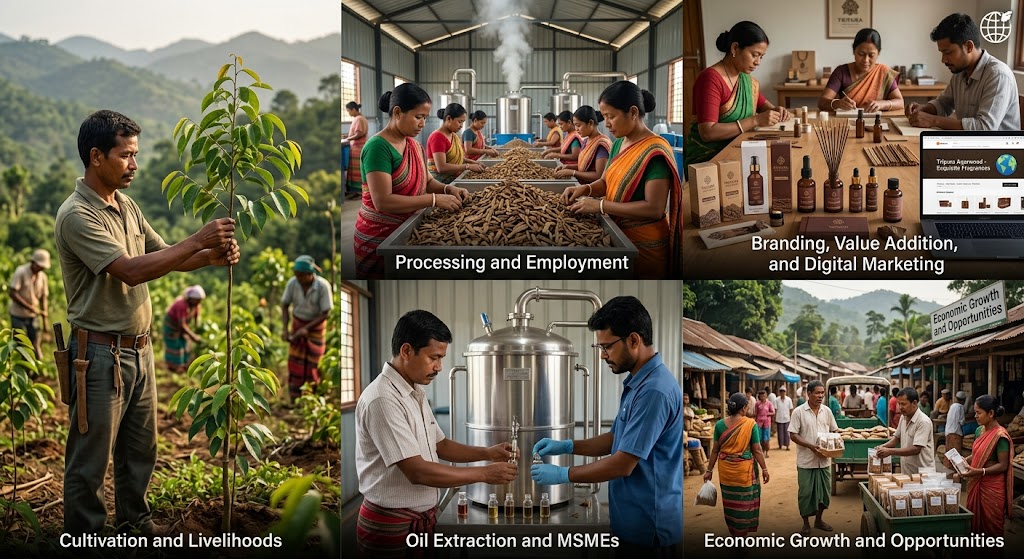
In the villages of Tripura, agarwood has long been part of local livelihoods and traditional trade. What was once largely seen as a forest-based and household-linked activity is now attracting attention as a potential high-value business sector that could create new opportunities for farmers, entrepreneurs and workers.
The real opportunity for Tripura lies not simply in growing agar trees, but in building businesses around everything that comes after cultivation. From processing and oil extraction to fragrances, packaging and exports, agarwood can support an entire value chain and bring more economic activity closer to rural communities.
Agarwood is particularly valuable because its commercial potential extends beyond the raw wood. Processed agarwood is used in products such as perfumes, incense and other aromatic products, creating opportunities for businesses to turn locally available resources into higher-value goods.
From cultivation to a wider business ecosystem
For farmers, agarwood cultivation can provide a long-term commercial opportunity. But the economic impact can become much larger when local processing facilities are developed alongside plantations.
A farmer may begin with cultivation, while another entrepreneur can operate a processing unit, a local worker can find employment in sorting or extraction, and other businesses can handle transportation, packaging and distribution. In this way, one industry can create several connected sources of income.
This value-chain approach is particularly important for rural economies because it allows economic activity to spread across different groups rather than remaining concentrated in raw-material trading.
Opportunities for MSMEs and entrepreneurs
Agarwood also has the potential to open a new space for small and medium-sized enterprises in Tripura.
Entrepreneurs can explore businesses related to oil extraction, incense manufacturing, fragrance products, packaging, branding and retail. With better market connections, even small enterprises could potentially sell specialised agarwood-based products beyond local markets.
The rise of e-commerce and digital marketing could further widen this opportunity. Small producers can use online platforms to introduce locally made products to consumers in other parts of India and, where regulations and market requirements permit, international buyers.
Employment beyond the plantation
The business potential of agarwood is not limited to farmers. A growing industry can create demand for workers involved in cultivation, harvesting, processing, quality control, oil extraction, packaging, transportation and sales.
For rural youth, this could create opportunities to find work closer to home or build small enterprises linked to the agarwood supply chain. Training in modern processing, product development and marketing could help create a skilled workforce around the sector.
Value addition can increase economic returns
One of the biggest opportunities for Tripura is to move further up the value chain.
Selling raw material generally captures only one part of the potential economic value. Processing the material into oil, fragrances, incense and other finished or semi-finished products creates additional stages where businesses can generate revenue.
This can also encourage investment in local processing infrastructure. As more businesses participate in value addition, demand can grow for machinery, packaging materials, storage, transportation and professional services.
Export potential adds another dimension
Agarwood has an established place in the global fragrance and aromatic-products market. This gives Tripura an opportunity to develop an export-oriented industry, provided producers and businesses can meet quality, sustainability, certification and regulatory requirements.
Building reliable supply chains and improving processing standards would be important for businesses seeking access to premium markets. Branding Tripura-origin products could also help create a stronger identity for the state's agarwood industry.
A boost to the wider economy
The economic impact of a stronger agarwood sector could extend well beyond plantations and processing units.
When farmers earn from cultivation, they spend more within local markets. Processing units generate jobs, transporters get more business, packaging companies receive additional orders and traders gain access to larger markets. This creates a chain of economic activity across multiple sectors.
For the government, the growth of organised businesses can also contribute to formalisation and additional revenue while supporting rural enterprise development.
Technology and digital marketing can change the market
Technology could play an important role in taking Tripura’s agarwood industry to the next stage.
Modern extraction and processing techniques can improve product quality, while digital platforms can help producers connect directly with customers, distributors and buyers. Digital marketing can also help small businesses tell the story behind their products, build brands and reach markets outside the Northeast.
This is especially relevant for premium products, where packaging, product information, brand identity and customer trust can influence purchasing decisions.
Sustainability will remain important
The expansion of the agarwood business will also need to be accompanied by responsible cultivation and sustainable practices. Long-term commercial growth depends on maintaining the resource base while ensuring that farmers and businesses have clear and viable legal pathways to participate in the market.
A well-managed industry can therefore combine traditional knowledge with modern business practices, creating economic value without losing sight of environmental considerations.
Tripura’s next big value-chain opportunity
Agarwood has the potential to become an important rural business opportunity for Tripura if the focus moves from cultivation alone towards processing, product development, branding, digital marketing and exports.
The sector can connect farmers with MSMEs, workers with new employment opportunities and local products with wider markets. With investment in skills, technology, infrastructure and market access, agarwood could evolve into a stronger value-added industry and contribute to Tripura’s broader economic development.
For the state, the opportunity is not just about selling agarwood. It is about building businesses around it—and ensuring that a larger share of the value created reaches the farmers, entrepreneurs and communities at the heart of the industry.